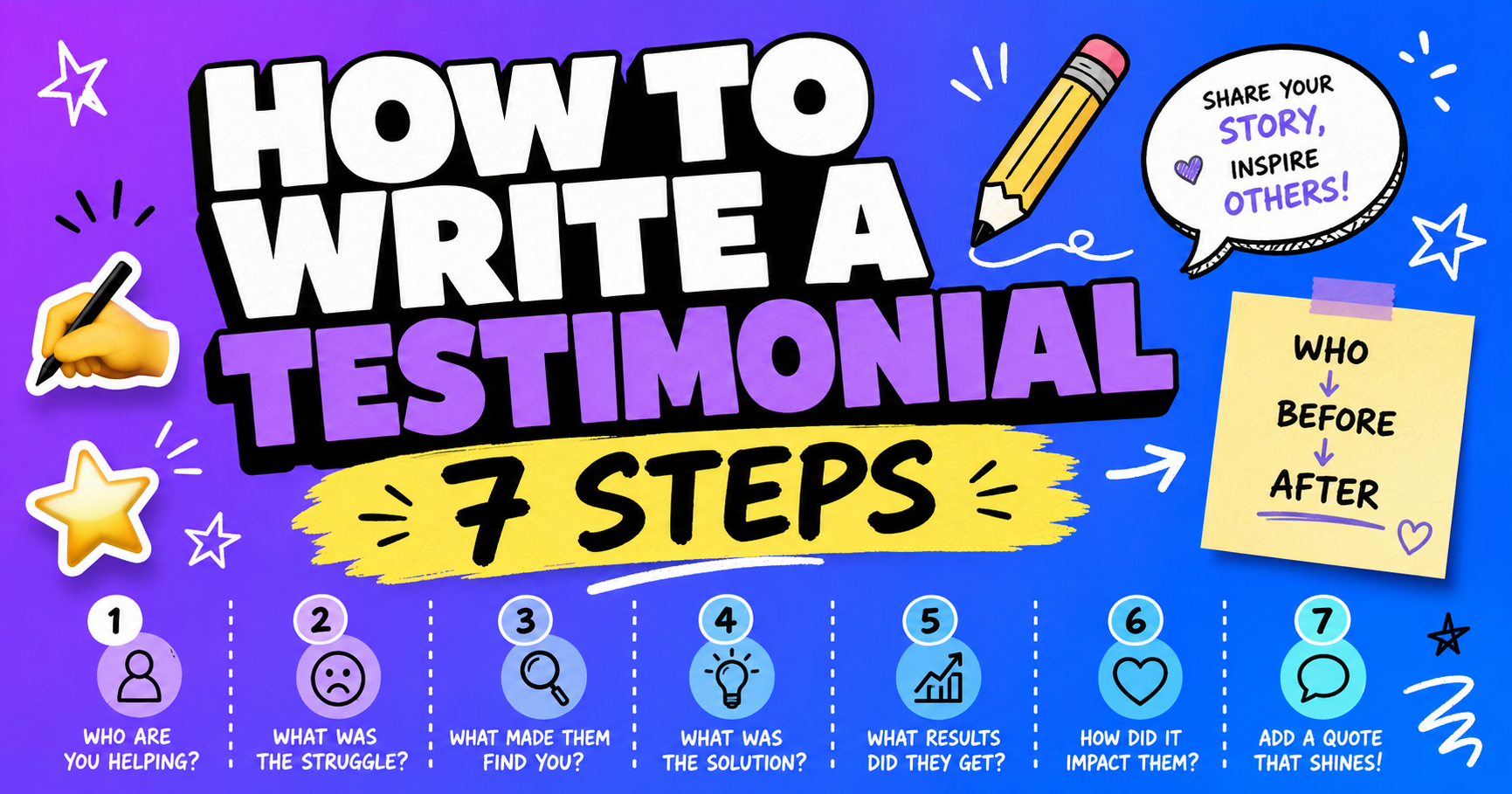
How to write a testimonial means capturing a specific result, naming who you are, and making the reader feel what changed - in 3-5 sentences. Done right, a testimonial moves buyers faster than any ad copy. Done wrong, it's ignored. This guide gives you 7 steps, fill-in-the-blank templates, real examples, and the exact format that converts.
---
What makes a good testimonial? (The 3-sentence rule)
A good testimonial answers three questions in order: Who are you? What was the problem? What changed after? That structure alone puts you ahead of 80% of testimonials published today, most of which are vague praise ("Great service! Highly recommend!") that buyers discount immediately.
According to BrightLocal's 2024 Local Consumer Review Survey, 79% of consumers trust online reviews as much as personal recommendations - but only when those reviews contain specific details. Generic praise earns almost no trust lift.
The three-question framework keeps every word earning its place:
- Who - your role, company, or context (gives credibility)
- Before - the friction, fear, or gap you had (gives relatability)
- After - the specific result, number, or feeling (gives proof)
| Weak testimonial | Strong testimonial |
|---|---|
| "Great product, love it!" | "As a solo founder, I was losing 3 hrs/week chasing Google reviews. StarHQ automated the ask - we hit 50 reviews in 6 weeks." |
| "Really helpful team." | "Their onboarding call fixed our Zapier integration in 20 minutes. First week: 12 new testimonials without any manual follow-up." |
| "Would definitely recommend." | "Switched from Senja. Import took 4 minutes. Our widget now loads in under 200 ms - clients notice." |
---
How to write a testimonial in 7 steps
Follow these steps whether you are writing a testimonial for a business you used, a product you loved, or a person who helped you.
Step 1 - Start with your specific situation
Open with one sentence about who you are and what problem you brought in. Readers scan for someone who looks like them. If they see themselves in sentence one, they read on.
Template:
"As a [your role] at [company type], I was struggling with [specific problem] before [product/person]."
Example:
"As the marketing lead at a 12-person e-commerce brand, I was struggling to collect social proof consistently before we found StarHQ."
Step 2 - Name the before-state honestly
Resist the urge to jump straight to praise. The before-state is what makes your result believable. Quantify if you can: time wasted, money lost, stress level, conversion rate.
Template:
"We were [specific pain point] - [quantify if possible] - and nothing we tried [previous solution] was working."
Example:
"We were manually emailing customers one by one - maybe 2-3 responses a month - and our Google review count had stalled at 11 for over a year."
Step 3 - Describe the turning point
One sentence. What made you try this product or person? This is where skepticism gets addressed - readers wonder "why them?" before they wonder "did it work?"
Template:
"I [found / was referred to / tried] [product/person] because [one honest reason]."
Step 4 - State the specific result
This is the most important sentence in the testimonial. Numbers beat adjectives every time. Wyzowl's 2024 State of Video Marketing Report found that testimonials with specific metrics drive 34% more click-throughs than those without.
Acceptable result types:
- Hard numbers: revenue, time saved, leads generated, reviews collected
- Percentage change: "conversion rate went from 1.8% to 3.4%"
- Time frame: "within 30 days," "in the first week"
- Comparison: "3x more than our previous tool"
Template:
"[Specific metric] improved by [amount] in [timeframe]. [One sentence on what that meant for the business/life]."
Step 5 - Add one sentence of emotional truth
Forrester Research found that emotionally engaged customers are 3x more likely to recommend a brand. Pure data testimonials feel transactional. One sentence of honest feeling - relief, surprise, confidence - makes the testimonial human and memorable.
"Honestly, I was skeptical. Seeing 40 new reviews appear in a month felt like we'd finally caught up with competitors we'd envied for years."
Step 6 - Close with a recommendation or call to action
End the testimonial with a direct recommendation. "I'd recommend X to anyone who [specific qualifier]" is more persuasive than a general "highly recommend" because it signals the writer thought about fit.
Template:
"If you [specific qualifier], [product/person] is the [one word: tool/person/platform] I'd go to first."
Step 7 - Attach your name, role, and (if possible) a photo or logo
Nielsen's Trust in Advertising report consistently shows that attributed testimonials outperform anonymous ones by 2.4x. A name + role + headshot is the difference between "someone said this" and "a real person with stakes said this."
Full format:
[First name] [Last name]
[Job title], [Company name]
[Optional: city or industry]
---
Testimonial format: short vs. long vs. video
Not every testimonial needs to be a paragraph. The right length depends on where it lives.
| Format | Ideal length | Best placement | Conversion use case |
|---|---|---|---|
| One-liner | 1 sentence, 15-25 words | Homepage hero, pricing page | Reduce bounce, build instant trust |
| Short paragraph | 3-5 sentences, 60-100 words | Landing pages, email | Decision-stage buyers |
| Long-form case study | 200-500 words | Blog, sales deck | Late-stage enterprise deals |
| Video testimonial | 45-90 seconds | Product pages, ads | High-ticket or complex products |
| Star rating + text | 30-60 words | Google, G2, Capterra | Local/SaaS search discovery |
StarHQ supports all five formats and lets you embed any of them as a responsive widget - without touching your codebase.
---
How to write a testimonial for a person
Writing a testimonial for a person - a colleague, mentor, freelancer, or service provider - follows the same structure but shifts the focus from product results to human qualities demonstrated through action.
The key rule: never describe character directly. Show it through a specific incident.
Weak: "She is incredibly professional and dedicated."
Strong: "When our launch deadline moved up by two weeks, she restructured the entire project plan overnight and delivered on time without cutting scope."
Template for a personal testimonial
"[Name] helped me [specific outcome] when [specific situation]. What stood out was [one specific behavior or decision], which [concrete result or impact]. I'd work with [Name] again without hesitation and recommend them to anyone who needs [their specific skill]."
What to include in a professional recommendation
- Context: how long you worked together and in what capacity
- One concrete challenge they solved
- One quality demonstrated through action, not adjective
- A clear recommendation with a qualifier
LinkedIn recommendations follow this format exactly. Recruiters and hiring managers skim for specifics - same cognitive pattern as a buyer reading a product testimonial.
---
How to write a testimonial for a business
When writing a testimonial for a business - a restaurant, agency, SaaS tool, law firm, retail store - the reader is a future customer evaluating fit. Your job is to remove their biggest objection.
Think about why you hesitated before buying. Address that in the testimonial.
Common objections to address by industry
| Industry | Common buyer objection | Address it by saying… |
|---|---|---|
| SaaS / software | "Will setup take forever?" | "Up and running in under an hour…" |
| Agency / freelance | "Will they understand my niche?" | "They learned our industry fast - first draft needed one revision." |
| Restaurant / local | "Is it worth the price?" | "Best value in the neighborhood for what you get." |
| Coaching / consulting | "Is this actually results-based?" | "Hit my revenue target 6 weeks into the program." |
| E-commerce | "Will it arrive/work as described?" | "Exactly as pictured, arrived 2 days early." |
Google review format (what to say in a testimonial for local search)
BrightLocal data shows Google reviews under 100 words that mention the business name, a specific service, and a staff member by name rank better in local results and get more helpful votes.
Template:
"I visited [Business Name] for [specific service]. [Staff name] was [one specific thing they did]. What I appreciated most was [specific detail - price, speed, quality, communication]. I'll be back for [next use case] and recommend them to anyone in [city/neighborhood] looking for [service]."
---
What to say in a testimonial (when you don't know where to start)
Writer's block on testimonials is real. Most people want to help but freeze in front of a blank text box. Use these five prompts to unlock the right words:
- What were you afraid of before buying? ("I worried it would be too technical…")
- What surprised you most? ("I didn't expect to see results this fast…")
- What would you tell a friend who asked about this? (People speak naturally in this frame)
- What's one number or metric that changed? (Forces specificity)
- Would you buy again? Why? (Surfaces the real value)
StarHQ sends these prompts automatically in its review-request flows, which is why the testimonials it collects tend to be 3-4x more specific than open-ended review requests. See also: how to collect testimonials.
---
Good testimonial examples (annotated)
Example 1 - SaaS product (short paragraph)
"We were spending 2 hours a week manually following up with clients for Google reviews. StarHQ cut that to zero - 47 new reviews in the first 60 days, all on autopilot. Our local ranking moved from page 2 to the top 3. Setup was 25 minutes. I'd recommend it to any agency tired of chasing clients for reviews."
>
- Jordan Mills, Operations Manager, Bright Digital Agency
Why it works: specific time saved, specific result (47 reviews, 60 days), specific ranking change, setup time as objection-removal, qualified recommendation.
---
Example 2 - Freelancer / person testimonial
"I hired Marcus to redesign our checkout flow under a tight 3-week deadline. He flagged a UX issue in our cart that we'd missed for two years - fixing it was outside scope, but he did it anyway. Our checkout conversion rate went from 2.1% to 3.8% in the following month. He's the first person I call for conversion-focused design."
>
- Priya Sharma, Head of Growth, Noon Commerce
Why it works: specific timeline, proactive action (outside scope), quantified conversion lift, clear recommendation with qualifier.
---
Example 3 - One-liner for homepage hero
"Went from 11 Google reviews to 94 in 8 weeks. No manual work."
>
- Tom Bauer, Owner, Bauer HVAC
Why it works: pure numbers, no fluff, handles one objection (manual effort), attribution is credible (owner, named business).
---
Example 4 - Long-form case study opening
"Before StarHQ we had a consistent 3.9-star average across 22 reviews - not bad, but not enough to win the trust of enterprise clients comparing us to agencies with 200+ reviews. We tried asking manually. We tried adding a link to our email footer. Neither worked consistently.
>
Three months after implementing StarHQ's automated request flow, we had 118 reviews and a 4.7-star average. Our sales team now leads discovery calls with the widget embedded in our proposal deck. Pipeline conversion went up 18% quarter-over-quarter."
>
- Elena Voss, CEO, Voss Creative Studio
Why it works: opens with exact before-state numbers, lists failed alternatives (builds empathy), delivers specific multi-metric result, shows downstream business impact.
---
Common testimonial mistakes (and how to fix them)
Mistake 1 - Pure adjectives, no evidence
"Amazing company, great people, fantastic service." Every competitor says the same thing. Fix: replace each adjective with a fact.
Mistake 2 - Too long, no structure
A testimonial over 150 words without a clear arc loses readers. Fix: one sentence per step (situation → problem → result → recommendation).
Mistake 3 - Anonymous or underattributed
"- Happy customer" or initials only. Fix: full name + role + company at minimum.
Mistake 4 - No permission
Using testimonials without explicit consent is a legal and trust risk. Fix: use a platform that captures consent at submission - this is table stakes for any testimonial collection tool worth using.
Mistake 5 - Buried below the fold
Testimonials placed at the bottom of a page are seen by fewer than 15% of visitors (Nielsen Norman Group scroll depth data). Fix: put your highest-impact one-liner in the hero, above the fold.
---
How to collect testimonials that write themselves
The best testimonial strategy is not writing better testimonials - it is asking better questions at the right moment. A well-timed, well-prompted request produces specific, quotable testimonials without any editing on your part.
The optimal moment to ask: immediately after a customer achieves a result. For software, that's after a milestone. For services, after delivery. For e-commerce, 7-10 days after delivery when the product is in use.
StarHQ automates this entire loop - sends the request at the right moment, prompts with the five questions above, collects consent, and embeds the result in a widget you can drop onto any page in minutes. No code. No chasing. No editing vague praise into something usable.
If you are serious about turning customer words into revenue, the fastest path is a system that makes it effortless for customers to say the right things - not a blank text box and a hope.
Start collecting high-quality testimonials today with StarHQ - and turn every satisfied customer into your best sales asset.